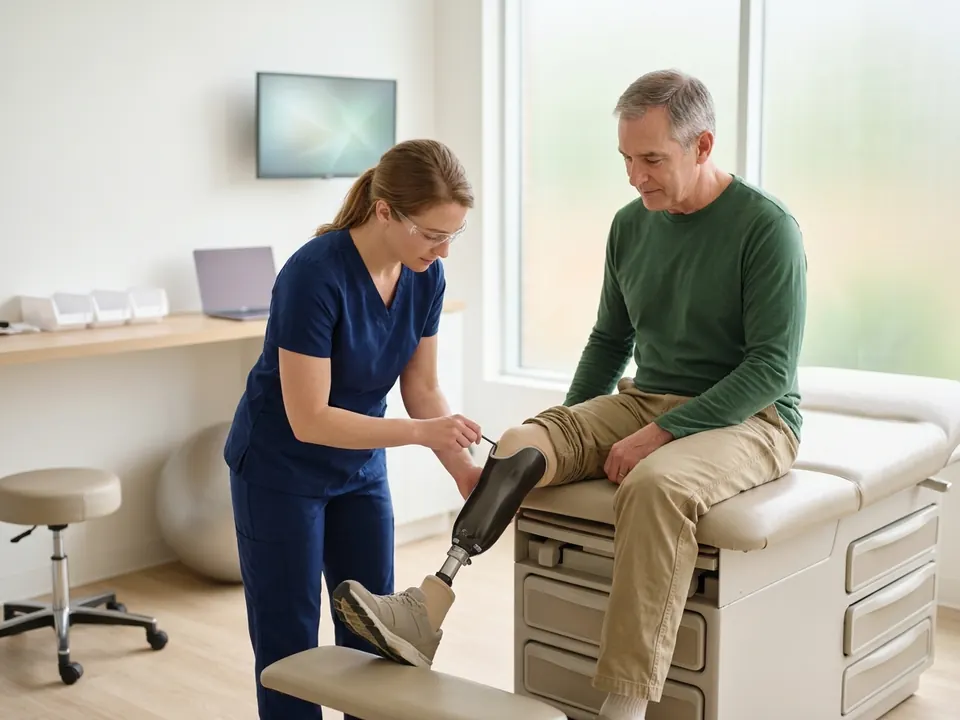
Prosthesis for a limb (leg or arm) features a cover, a socket in a rigid frame (interface), and components. The interface allows the prosthesis to be attached to the body. Components consist of terminal devices (like artificial toes, feet, hands, or fingers) and artificial joints.
Who is amputee rehabilitation for? Amputee rehabilitation is suitable for people who have got congenital lower or upper extremity amputations. Congenital amputations can be found at birth when a baby is born without part or all of a limb. Acquired amputations are often from surgery, illness, or injury. Some acquired causes, which may result in an amputation are:
- Peripheral Vascular Disease or PVD (blood vessel disease)
- Gangrene
- Diabetes
- Arteriosclerosis (hardening of the arteries)
- Infection
- Frostbite
- Tumors/cancers in muscle and bone
- Injury/trauma
What does amputee rehabilitation entail? The rehabilitation program starts with an extensive evaluation and development of a personalized care plan. The plan is focused on developing the skills an amputee requires to re-learn vital skills. Some popular treatment areas are:
- Strength
- Balance
- Flexibility
- Gait training and mobility
- Sensation training/pain management
- Improving activity persistence
- Self-care activities
- Safety
- Home management skills
- Coping skills and body image
- Independence with community mobility
- Training, education, and use of assistive devices and adaptive equipment
Rehabilitation might occur in various environments, which include: outpatient rehabilitation, acute rehabilitation facility, acute care, home care and hospital-based skilled nursing facility.
How long will amputee rehabilitation take? The duration of rehabilitation differs depending on each person's progress and needs. There are several stages of rehabilitation, which are determined by the time since the amputation, and extent of healing.
Pain
After a leg or an arm amputation, people might feel pain, which appears to be in amputated limb. The pain is genuine; however, the location is mistaken. Phantom pain is most likely if pain before amputation lasted for long or was severe. Phantom pain is usually worse shortly after the amputation and then reduces with time. For most people, phantom pain is more frequent when the prosthesis isn't being worn (for instance, at night). If a general anesthetic and a spinal anesthetic are used during the procedure, the risk of experiencing this pain is decreased.
Some people suffer from phantom limb sensation that isn't painful but feels as though the amputated limb is still there. When people with an amputated leg get this feeling, they might stand up, thereby fall back down. This experience often happens during the night when people wake up to use the washroom.
The stump itself might be painful. Massaging the stump at times helps ease this pain.
 Private Hospital
 ISO